By clicking “Accept All Cookies”, you agree to the storing of cookies on your device to enhance site navigation, analyze site usage, and assist in our marketing efforts. View our Privacy Policy for more information.
The Toughest Decisions Usually Feel the Worst
Kyle Brown shares the personal side of moving KBP into a 15,000-square-foot facility—the financial pressure, self-doubt, losing his own training routine, learning to trust his coaches and gaining perspective on taking major risks.
By
September 28, 2026
Related

Estimated Read Time: 11–12 minutes
I've been thinking about writing this for a while, and I'm still not entirely sure I've had enough distance from everything to fully understand it.
Maybe that's why now is actually the right time to write it.
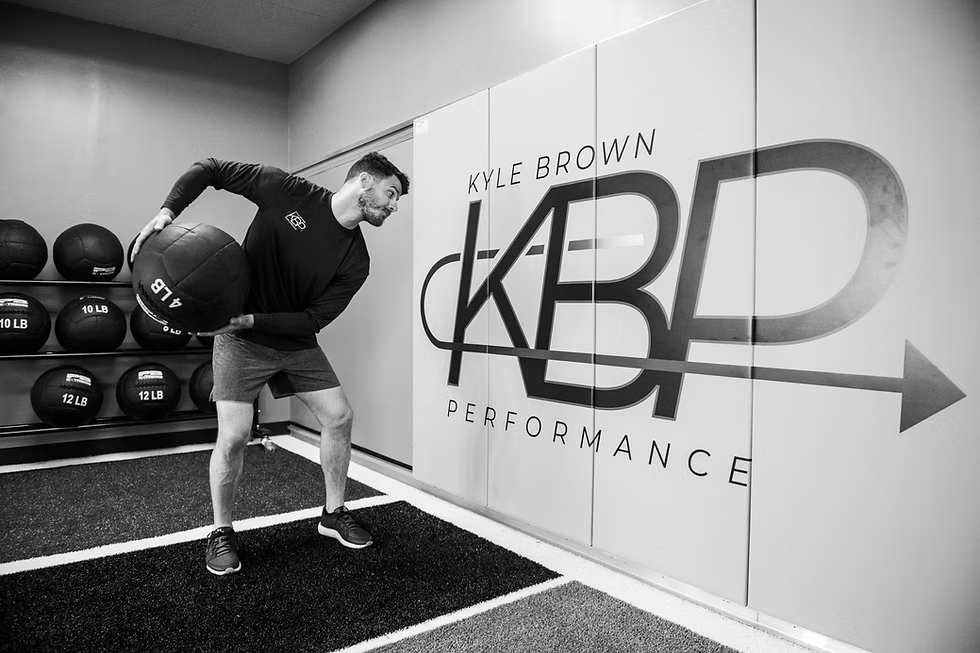
Moving Kyle Brown Performance into a 15,000-square-foot facility was one of the biggest decisions I've made professionally. If you looked at it from the outside, you'd probably call it growth. We were moving into a much larger building. We had more room for athletes, more room for adults, more equipment, more possibilities and an opportunity to build something closer to what I had always imagined KBP could become.
It should have felt exciting.
Sometimes it did.
A lot of the time, it didn't.
For a stretch, it felt like every day started with a list of things I needed to accomplish, and no matter how hard I worked, the list was longer when I went to bed.
I'd cross one thing off and add three.
There was always another decision to make. Another person to call. Another thing to buy. Something that needed to be fixed. Something that hadn't arrived. Something that cost more than I expected. Something at the old facility that still needed my attention while I was trying to prepare the new one.
At the same time, KBP didn't stop operating because I was overwhelmed.
Clients still walked through the door.
Athletes still needed programs.
Coaches still needed answers.
Payroll still happened.
My family still needed me.
Life didn't give me a few months off to move a business.
I don't think I appreciated that part before I started.
I knew moving would be difficult. I knew it would be expensive. I knew there would be stress.
Knowing something intellectually and living it every day are very different things.
And if I'm being completely open, the biggest source of stress was money.
Not because that is particularly unique to me. Anyone who has built a business probably understands exactly what I'm talking about.
You're spending money based on something that doesn't exist yet.
You're making decisions today based on what you believe will happen tomorrow.
You can build spreadsheets. You can make projections. You can look at membership numbers. You can convince yourself that you've calculated the risk.
Then you actually sign the lease.
You buy the equipment.
You pay for flooring.
You move.
You open the doors.
And suddenly those numbers aren't sitting in a spreadsheet anymore.
They're real.
Then comes the part nobody can guarantee.
Will people come?
One of the major reasons we needed this facility was athletes.
We had reached a point where I believed KBP needed more room to become what I wanted it to become. I could see the opportunity.
So we made the move.
And I remember looking around after we opened and thinking:
Where are the athletes?
That's difficult for me to write because I'm supposed to be the confident one.
I'm the owner.
I'm the person who made the decision.
I'm supposed to have the plan.
But there were absolutely moments when I questioned whether I had made the right call.
We built the capacity.
I believed in our coaching.
I believed in our programming.
I knew what we could offer.
So where was everybody?
That's when I learned another lesson that I probably already knew but didn't particularly want to accept:
The public doesn't care about your timeline.
People have their own lives.
Families have schedules.
Kids are playing multiple sports.
People have financial commitments.
Some people want to train but won't commit.
Some people say they're going to sign up and don't.
Some people need six months to make a decision you thought would take six days.
You can believe wholeheartedly in what you've built and still have absolutely no control over when somebody decides to walk through your door.
That bothered me.
A lot.
I started looking at our growth too closely. I'd look at numbers and immediately judge the entire move based on what had happened that week.
Good week?
Great decision.
Slow week?
What the hell did I do?
That's not a particularly healthy way to evaluate a seven-year decision.
But that's easy to say now.
It wasn't easy when I was in it.
Something else happened during that period that was probably an even bigger warning sign.
I stopped training.
That sounds ridiculous.
I own a gym.
I spent years of my life training at an extremely high level. Training helped take me around the world with Team USA competing in Skeleton. It shaped a huge part of who I am. Eventually, I built my entire career around helping other people train.
And somehow I couldn't find time to do it myself.
At least that's what I told myself.
I didn't have time.
I didn't have energy.
There was too much to do.
Someone needed me.
Something needed to be handled.
I'd get to my own training later.
Later became tomorrow.
Tomorrow became next week.
Eventually I had to admit something I didn't particularly like admitting.
I had gotten lazy about myself.
There wasn't some complicated reason.
I put everyone and everything else in front of me, and after doing that long enough, I started treating my own training like it was optional.
The ironic part is that this is exactly the behavior I challenge our clients on all the time.
We hear it constantly.
“I don't have time.”
Work is busy. Kids have sports. Something came up. The schedule is crazy.
And here I was doing exactly the same thing.
I had a 15,000-square-foot training facility filled with equipment and couldn't manage to consistently give myself an hour.
At some point, I realized that wasn't something to be proud of.
It wasn't evidence that I was working harder than everyone else.
It wasn't noble.
I had simply stopped taking care of something that matters to me.
I've started training consistently again.
And I didn't realize how badly I needed it until I did.
Training has always been one of the few places where I can completely shut everything else off.
When I'm actually training, I'm not thinking about a lease.
I'm not looking at membership numbers.
I'm not answering a text.
I'm not wondering whether we should change a schedule.
I'm not thinking about payroll.
I'm just there.
Training.
For a long time, that was such a normal part of my life that I don't think I appreciated what it did for me mentally.
Losing it made me understand it differently.
And taking that time back has changed the way I look at the business too.
For a while I think I believed that every minute I wasn't working on KBP was a minute I wasn't giving enough to KBP.
I see that differently now.
There is a point where constantly giving more stops making you better at what you're doing.
Sometimes you need to leave.
Sometimes you need to train.
Sometimes you need an hour where you aren't the owner.
And I've started realizing that making time for myself doesn't mean I'm giving less to everyone else.
It might actually allow me to give them something better.
The same lesson has started showing up in how I work with our coaches.
I've always cared deeply about the quality of coaching at KBP. When your name is on the business, it's hard not to feel personally responsible for every single thing that happens inside it.
That can turn into wanting to control everything.
It's faster if I do it.
I know exactly how I want it done.
I'll just handle it.
That works for a while.
Then the business grows.
Eventually, trying to personally hold every piece together doesn't make you a dedicated owner.
It makes you the bottleneck.
I'm learning that.
Probably slower than I should.
I have good coaches around me.
And if I want them to become great coaches and leaders, I have to actually give them opportunities to do that.
That means responsibility.
It means ownership.
It means allowing them to make decisions.
And sometimes it means allowing them to do something differently than I would have done it.
That's hard.
But there's something selfish about saying you want your staff to grow while refusing to give them enough responsibility to actually grow.
I'm starting to understand that my job isn't to make sure KBP can never function without me.
My job is to build KBP into something that doesn't require me to personally touch everything.
That's a different definition of success than I had a few years ago.
I think that's the biggest thing this move has done.
It's changed my perspective.
When you're in the middle of something difficult, your field of vision gets really small.
You're thinking about today.
This bill.
This problem.
This membership number.
This conversation.
This thing that didn't go according to plan.
You can be standing in the middle of something you've spent years trying to build and still only see what's wrong with it.
I've done that.
There have been days where I've stood inside this facility thinking about what we don't have yet instead of looking at what is already here.
That's a miserable way to experience progress.
I'm trying to get better at zooming out.
KBP didn't start in this building.
There was a time when having a facility like this would have sounded ridiculous.
Now I'm standing in it worrying that it isn't growing fast enough.
That's ambition, but unchecked, ambition can make you pretty ungrateful.
There's always another number.
Another goal.
Another thing to fix.
Another level.
At some point you have to be able to acknowledge that something can be unfinished and still be worth being proud of.
KBP is unfinished.
So am I.
I still want more athletes in the building.
I still want the business to grow.
I still look at numbers.
I still worry about money.
I still have days where the to-do list gets the better of me.
None of that disappeared because I gained some perspective.
I just don't think those things get to determine whether the move was successful anymore.
The facility gave KBP room.
Now we have to grow into it.
And maybe I needed to grow into it too.
I've thought a lot throughout this process about difficult decisions and why they feel the way they do.
We like to imagine that making the right decision comes with some kind of immediate confirmation.
You make the leap.
Everything works.
You feel relieved.
Everyone tells you that you made the right call.
That's not how this felt.
The decision created more stress before it created opportunity.
It created more uncertainty before it created confidence.
There were days when taking the risk felt significantly worse than staying comfortable would have felt.
And yet, knowing what I know now, I'd still do it.
Maybe that's the lesson.
The toughest decisions are typically the worst feeling, but the correct ones.
I don't mean that every painful decision is automatically right. Obviously it isn't.
I mean that sometimes the correct decision removes the comfort that was making your old life manageable.
You wanted growth.
Growth creates new problems.
You wanted opportunity.
Opportunity requires risk.
You wanted something bigger.
Bigger requires you to become capable of carrying something you haven't carried before.
That process isn't always inspiring.
Sometimes it just sucks.
I don't know exactly what KBP will look like five years from now.
That's uncomfortable for me to admit because I like having a plan.
I know what I want.
I know what we're working toward.
But I've become a little more accepting of the fact that I don't control all of it.
What I do control is what happens next.
I can continue making our programming better.
I can continue developing our coaches.
I can create a better experience for our clients.
I can work to bring more athletes through the doors.
I can make smarter business decisions.
And I can make sure I don't completely lose myself while doing it.
That last one might be the biggest lesson I've taken from this entire process.
I'm back to training.
I'm trying to give my coaches more.
I'm trying to give myself permission to occasionally step away.
I'm trying to look at what we've built without immediately searching for what's missing.
Some days I'm better at all of those things than others.
But I'm working on it.
Maybe a year from now I'll read this and laugh at what I thought was stressful.
Maybe I'll see things completely differently.
I hope I do.
That's probably the point.
Right now, I'm learning to be okay with being in the middle of it.
The facility isn't full yet.
The vision isn't finished.
Neither am I.
But we're here.
We took the risk.
And now we get to find out what we can build with it.


.jpg)